
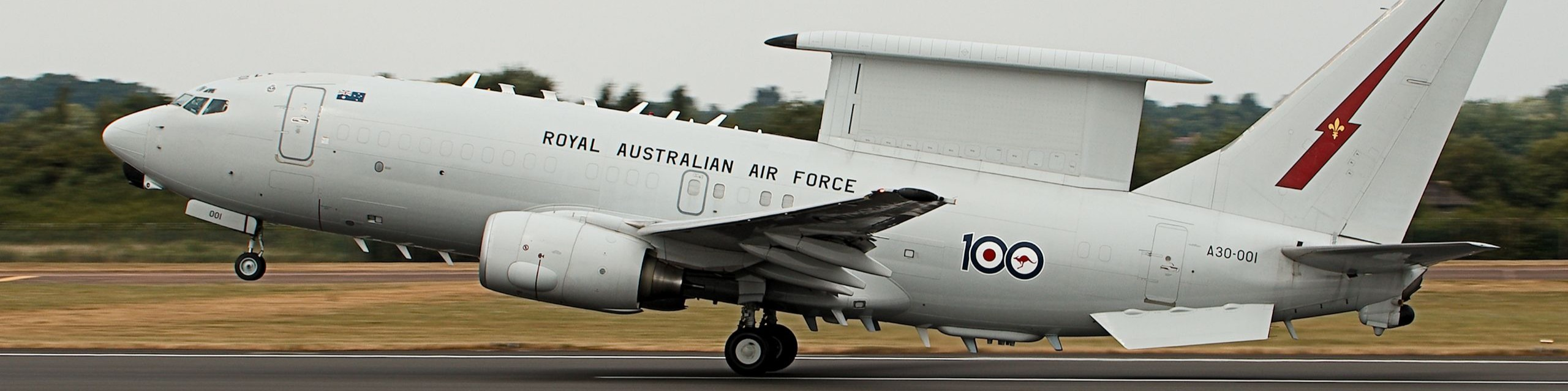
America’s Air Force is out of practice in contesting the skies, with no recent air-to-air combat experience to draw upon. For two decades, counterinsurgency operations over Iraq and Afghanistan delivered unchallenged air supremacy, treating air battle management – the real-time orchestration of fighters, sensors, and strikes – as an afterthought. That permissive era is over. China’s People’s Liberation Army Air Force (PLAAF) fields over 600 modern fighters and advanced airborne early warning platforms like the KJ-500 and KJ-600, and soon, the KJ-3000, outpacing our aging E-3 AWACS and leaving a gaping capability hole. To reclaim air superiority in the Indo-Pacific, where a Taiwan conflict could erupt at any moment, the U.S. Air Force must urgently prioritize the E-7 to facilitate next-generation air battle management, a prerequisite for achieving air superiority.
The Lessons History Demands We Heed
Air battle management isn’t a luxury; it’s the force multiplier that turns airpower into a symphony of destruction. In the Battle of Britain, radar-fed controllers directed Spitfires to shred the Luftwaffe. In Desert Storm, air battle management led to 38 of 41 air-to-air kills. Fast-forward to today: Our E-3 fleet, acquired in the 1970s, limps along at mission-capable rates below 60%, relying on parts cannibalization from divested aircraft and 3D printed parts. The E-8 JSTARS is retired. Meanwhile, China has iterated AEW&C platforms like the KJ-200, KJ-500, KJ-600, KJ-2000, and KJ-3000, whereas the USAF has seen no comparable iterations of its legacy systems.
This isn’t theoretical. Although both Russia and Ukraine have employed fighter aircraft in unequal numbers, the absence of effective air battle management integrated with fighter operations has prevented either side from achieving air superiority, resulting in a prolonged stalemate. F-22s and F-35s are stealthy marvels, but even they can’t surveil an entire theater, deconflict fires, or manage a swarm of Collaborative Combat Aircraft (CCAs). A recent RAAF demonstration showcased the lethality: one E-7 operator controlled two MQ-28 Ghost Bats against airborne targets, fusing data for effective manned-unmanned teaming.
The Capability Gap Is Closing – Fast
The Air Force admits it needs 1,558 combat-coded fighters by 2035, nearly 300 more than it has today, but procurement lags amid R&D budget overruns. Without an E-7 to provide air battle management, the procurement of additional fighters is less effective. Without air battle managers to direct them, those fighter aircraft are limited in lethality.
Space-based moving target indication (AMTI) is seductive – persistent, global – but it’s no panacea. China’s “kill web” satellites and Russia’s ASAT tests (including the 2021 debris disaster) mean orbits are contested; a single cyber hit or nuke blacks out constellations. No satellite, datalink, or ground station exists that’s bulletproof in a near-peer fight. Layered resilience – space for persistence, ground for backup, air for dynamism – is the only path, with E-7’s MESA radar providing jamming-resistant surveillance over 300 miles.
Pentagon plans to cancel the E-7 for five Navy E-2Ds, and space-based solutions ignore timelines: E-7 prototypes roll out soon, full fleet by mid-2030s; space MTI? Similar timeframe at best, but together they provide resilience options for the joint force, while individually they present a single-domain target for our adversaries to negate air battle management effects. E-2Ds lack crew, range, and tanker compatibility for theater ops.
Congress Knows Better
Bipartisan lawmakers are sounding the alarm. The Senate Appropriations Committee allocated $647 million for E-7 development, effectively blocking its cancellation. House panels barred the use of funds to kill prototyping. Sixteen retired four-stars – including six ex-Chiefs – warned cuts undermine deterrence. The Department of War should capitalize on the US-UK trade agreement to build two USAF E-7 prototypes and ramp up acquisition to ensure no gap in air battle management matriculates.
A Clear Call to Action
To win the next air war, Congress should fully fund and accelerate E-7 procurement to 26 aircraft – $2-3 billion now saves trillions in defeat. USAF should partner with Australia and exercise with RAAF/JASDF for CCA-fighter teams. The E-7 is central to homeland defense under Golden Dome, detecting cruise missiles and drones as NORAD Commander Gen. Gregory Guillot testified.
Temporal air superiority – that hard-fought, time-bound edge – demands it. Air battle management, as enabled by the E-7 teamed with 5th-gen fighters, is the synthesis that ties together the joint force’s need for air superiority, ensuring coordinated lethality across domains and preventing adversaries from exploiting gaps in our command and control. Cancel the E-7, and China wins the sky. Fund it, and America owns it – again.
Lt Col Grant “SWAT” Georgulis, USAF, is a Master Air Battle Manager and currently assigned as the Deputy Chief of C2 Inspections as part of the Headquarters NORAD and NORTHCOM Inspector General team. He most recently finished a year-long Air Force National Defense Fellowship at The Mitchell Institute for Aerospace Studies for the academic year 2024-2025. He entered the Air Force in 2007 through the ROTC program at Texas State University–San Marcos. Lt Col Georgulis has served on a combatant command component staff, was an Air Force Weapons School instructor, and graduated from the Naval War College’s College of Naval Command and Staff and Air University’s School of Advanced Air and Space Studies. He previously commanded an E-3G Squadron, the 965 Airborne Air Control Squadron, at Tinker Air Force Base, Oklahoma.
The views expressed are those of the author and do not reflect the official policy or position of the U.S. Air Force, Department of Defense, or U.S. government.
Photo by Airwolfhound on Flickr via Wikimedia Commons
Leave a Reply