
The budget amendment matters for more than one airplane
The Pentagon’s decision to restore E-7 funding is not just a procurement correction. It is a belated recognition that the United States still needs airborne air battle management, and that no amount of futuristic rhetoric about space sensors can wish that requirement away. The latest budget amendment matters not because it rescues a single program, but because it acknowledges a larger truth: the joint force still depends on theater-wide command and control that can see the fight, sort the picture, direct forces, and manage time-sensitive action in real combat. AFA praised the amendment on May 13, and Lt Gen David Deptula said the reversal reflected the risks of not modernizing a capability whose cancellation would have created an unacceptable gap.
That is the right way to understand the E-7 debate. Too much of the discussion has treated the Wedgetail as merely a replacement aircraft, another aging-fleet recapitalization issue, or a temporary bridge to some future space-enabled architecture. That misses the real point. The argument is not fundamentally about one airframe. It is about whether the United States takes air battle management seriously enough to field a modern, survivable, relevant capability before the current one collapses due to age, scarcity, and combat pressure. The Air Force said as much in 2022, when it identified the E-7 as the only platform capable of meeting Department of Defense requirements within the required timeframe to replace the E-3. The fact that the Pentagon had to relearn that lesson in 2026 says more about institutional drift than about the aircraft itself.
Air battle management is broader than AMTI
The restoration also matters because it exposes a conceptual problem that has muddied this debate from the start: the conflation of Airborne Moving Target Indication with air battle management. Air & Space Forces Magazine reported that the long-term goal is to use space-based systems to replace the airborne targeting and management missions envisioned for the E-7, but that satellites still cannot fulfill the AMTI mission today. That is an important point, but it is not the whole point. AMTI is a sensing-and-tracking function. Air battle management is broader. It includes building and updating the operational picture, prioritizing threats, directing aircraft, deconflicting airspace, allocating effort, and turning information into action across a theater. Those are not the same thing.
The C2 Coord Podcast makes that distinction more directly from inside the community. The November 2025 episode The Airborne Layer of C2ABM explicitly lists AMTI is not Air Battle Management as one of the ideas underpinning the discussion of future airborne C2. That matters because the E-7 debate has too often been framed as if replacing a single sensor function would solve the larger command-and-control problem. It does not. A future space architecture may eventually contribute to AMTI. That still does not replace the broader theater-wide command and control role that air battle management platforms perform today.
That same point appears in C2 of ACE: Egress and Recovery, which argues that high-end conflict will require C2ABM platforms to manage aircraft recovery using radar, Link 16, secure UHF, SATCOM, chat relay, airfield status awareness, and coordination with the Air Operations Center. That is air battle management in action, and it is plainly broader than AMTI. It is about command, control, timing, communication, logistics awareness, and the orchestration of combat power. None of that disappears simply because an off-board sensor might one day provide a track.
The reversal happened because the gap was real
Air & Space Forces Magazine reported on May 12 that the Pentagon had initially zeroed out E-7 acquisition in the President’s budget request, only to reverse course and submit a budget amendment after congressional pushback and continued concern about the gap that would emerge if the E-3 retired without a replacement. Secretary Pete Hegseth testified that the E-7 was one of the systems that “still need to be funded” because it remains relevant on the battlefield right now. Lt Gen David Tabor likewise confirmed the Air Force had been working with the Office of the Secretary of Defense to restore funding. That is not the language of a luxury program. It is the language of a capability the department knows it still needs.
C2 Coord made a similar point last year in The Political Future of the E-7 Wedgetail. This post noted that the FY 2026 President’s Budget Request had omitted the program and argued that the future of Wedgetail would depend heavily on congressional appropriations. That piece was useful because it showed the issue was never really technical. The operational case for the aircraft had already been made. The danger was political drift, creating a capability gap by default. That is exactly what the budget amendment now seeks to undo.
Recent operations made the issue impossible to ignore
Recent operations stripped away whatever ambiguity remained. Air & Space Forces Magazine reported that the United States deployed six E-3 Sentry aircraft for Operation Epic Fury against Iran and that one was destroyed on the ground in a March 27 missile attack on Prince Sultan Air Base in Saudi Arabia. That single loss matters because these aircraft are few in number, operationally central, and difficult to replace quickly. It also matters because it exposes the flaw in treating airborne air battle management as a slowly modernized niche. Adversaries already understand the value of these aircraft. They know such assets are scarce, high leverage, and worth targeting. The United States should act as if it understands that, too.
That same recent fighting also undercut another lazy argument against the E-7. If other capabilities already in theater are enough, then why did Australia deploy an E-7A Wedgetail to support the allied effort? Air & Space Forces Magazine reported that Australia sent an E-7 to assist in detecting and defeating Iranian missiles and drones targeting UAE territory, even though U.S. E-3 and Navy E-2D capacity already existed in or around the broader fight. Actions matter here. Militaries do not surge scarce, high-value aircraft into an active theater for symbolism. They do it because the capability adds something meaningful. In this case, the practical verdict was clear: even with other airborne warning and control assets available, Wedgetail was still judged worth sending. That is one of the strongest possible arguments for the capability’s relevance.
Air battle management cannot be treated as an afterthought
There is a larger C2ABM lesson here. The United States has spent years talking about decision advantage, joint connectivity, and the need to operate inside an adversary’s decision cycle. All of that language is hollow if the force is unwilling to field the actual systems that make those ideas executable. Air battle management is what turns sensors into understanding and understanding into action. It is one of the functions that allows a collection of platforms to operate as a coherent combat force. That is why the E-7 cannot be dismissed as a legacy style fix. It is part of the infrastructure of modern airpower.
This C2 Coord author page reinforces that point across several essays. The recurring themes are clear in the excerpts available on the page: emerging C2ABM platforms offer real benefits at the onset of hostilities but will be limited by availability in the near term, while legacy mass still matters for sustained operations. That is exactly why the E-7 discussion should be understood through a C2ABM lens rather than a narrow acquisition lens. Air battle management is a warfighting function, not a line item.
The Air Force should stop buying too little and then buying twice
The Pentagon’s reversal should therefore be welcomed, but not romanticized. It was not a visionary act. It was a correction to an avoidable error. AFA and outside advocates helped force the department back toward a capability it had briefly tried to walk away from. That is useful in the near term, but it is not a healthy way to build a force.
The better lesson is that the Air Force should stop treating airborne air battle management as something to buy in minimum quantities and revisit later at greater cost. The service has already lived through that pattern with other fleets. It should procure the E-7 in the right numbers to support combatant command requirements from the outset, rather than setting conditions for another future scramble to revisit capacity shortfalls, as it has with the F-35 and F-15EX. Buying too little now only to buy more later is not thrift. It is simply paying more in future dollars for a problem that was already understood in present ones. That is especially true for a capability whose battlefield relevance, vulnerability, and scarcity have all been demonstrated in real operations.
The Way Forward
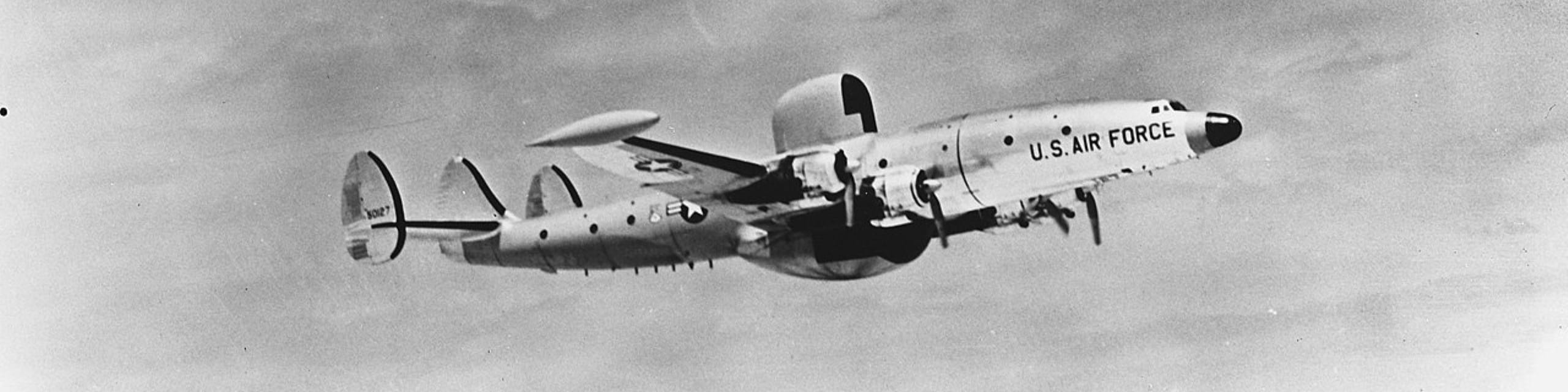
There is also a fitting symbolic point that the Air Force should consider as it moves forward. If the service is serious about restoring airborne air battle management as a core war-fighting function, then the U.S. E-7 – presently referred to by the Royal Australian Air Force’s name for their variant – should be named to reflect that heritage. “Constellation II,” or simply “Connie II,” would be a worthy choice, a direct harkening back to the EC-121 and a reminder that today’s fight still depends on the same basic truth: controlling the air domain requires crews and aircraft built to see the fight and manage it in real time. As the E-7 may grow into a future role where it facilitates the critical C2ABM function within a robust future multi-domain sensor constellation, the name is particularly apt.
The E-7 debate may yet prove useful if it leaves behind one durable lesson. AMTI is not air battle management. A future sensor constellation is not a present theater-wide command and control capability. And a force that is serious about winning in contested skies should stop pretending otherwise. The Pentagon’s reversal was a start. The harder task now is to buy, field, train, and sustain airborne air battle management in numbers that match the mission.
Col Grant “SWAT” Georgulis, USAF, is a Master Air Battle Manager and currently assigned as the Deputy Chief of C2 Inspections as part of the Headquarters NORAD and NORTHCOM Inspector General team. He most recently finished a year-long Air Force National Defense Fellowship at The Mitchell Institute for Aerospace Studies for the academic year 2024-2025. He entered the Air Force in 2007 through the ROTC program at Texas State University–San Marcos. SWAT has served on a combatant command component staff, was an Air Force Weapons School instructor, and graduated from the Naval War College’s College of Naval Command and Staff and Air University’s School of Advanced Air and Space Studies. He previously commanded an E-3G Squadron, the 965 Airborne Air Control Squadron, at Tinker Air Force Base, Oklahoma.
The views expressed are those of the author and do not reflect the official policy or position of the U.S. Air Force, Department of Defense, or U.S. government.
Photo Credit: U.S. Air Force
Leave a Reply