
In an era where the post-World War II “peace dividend” is rapidly eroding, global powers are once again jockeying for dominance in contested skies. From Russia’s grinding war in Ukraine to China’s aggressive buildup in the Indo-Pacific, the specter of great-power conflict looms larger than at any time since World War II. Amid this instability, securing air superiority, the ability to operate freely in the air while denying the same to adversaries, clearly is still a cornerstone of any successful military strategy. Moreover, as history teaches us, air superiority is not won by sheer numbers of aircraft or advanced weaponry alone; rather, it demands sophisticated air battle management: the real-time orchestration of sensors, communications, and decision-making to turn chaos into coordinated action. Nations like the United States must understand this history and apply its lessons to effectively wield this capability in modern conflicts. As is often the case, truly understanding the history of air battle management requires that we start at the beginning—we must first grasp its origins in the crucible of the Battle of Britain. Understanding this history illuminates why air battle management remains profoundly relevant today.
The Past
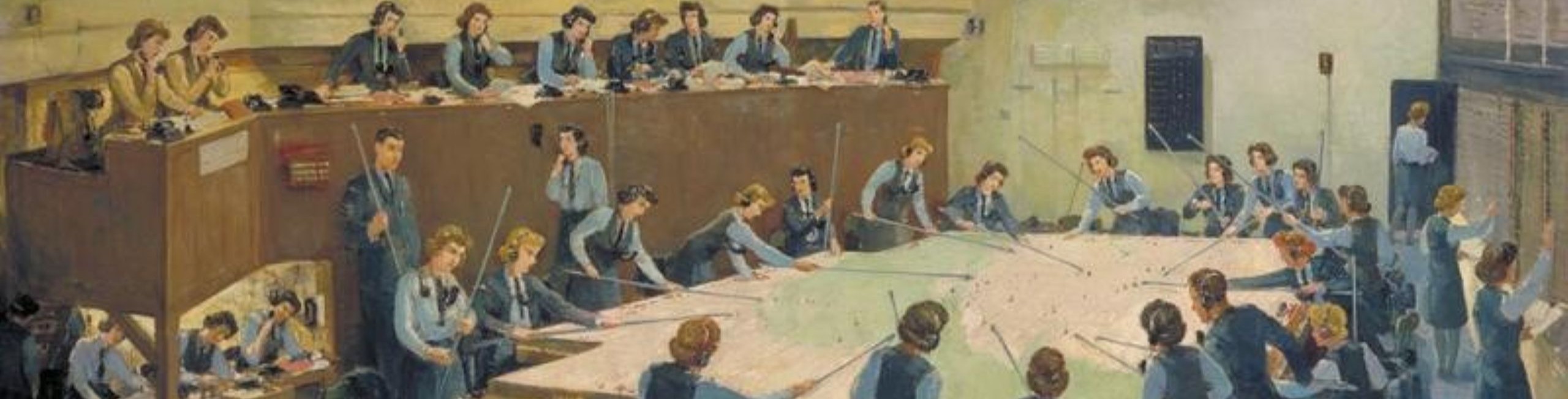
The dawn of air battle management broke over the English Channel in the summer of 1940, during one of the most pivotal air campaigns in history. As Stephen Bungay details in his seminal work The Most Dangerous Enemy: A History of the Battle of Britain, the Royal Air Force (RAF) faced overwhelming odds against the Luftwaffe. With just 446 operational fighters pitted against over 3,500 German aircraft, Britain’s survival hinged not on brute force but on innovative command and control and air battle management (C2ABM) systems. Under Air Chief Marshal Hugh Dowding, the RAF pioneered an integrated air defense network that fused radar detections, visual observers, and telephone communications into a coherent operational picture. Page 61 of Bungay’s book vividly describes the “Dowding System,” where Chain Home radar stations, tall, lattice-like towers scanning the horizon, provided early warning of incoming raids. These feeds flowed to filter rooms and sector operations centers, where plotters mapped enemy formations on large tables, enabling controllers to vector Spitfires and Hurricanes to intercept with precision. This was no ad hoc improvisation; it was the birth of systematic air battle management, allowing the RAF to concentrate limited resources, minimize losses, and wear down a numerically superior foe.
The system’s genius lay in its emphasis on information and decision dominance. Radar extended the RAF’s “eyes” out to about 50 nautical miles, while 30,000 observers scattered around the UK, organized into 50 observer posts, provided visual point-outs on Luftwaffe aircraft flying below radar coverage, used phone lines to call information in to the Observer Corps Centre, and relayed to Fighter Command HQ, which subsequently identified and directed the most appropriate forces to respond. The Battle of Britain proved that effective C2ABM could compensate for resource shortfalls, repelling the Luftwaffe and saving Britain from invasion. The RAF’s success, inflicting unsustainable losses on German bombers while preserving its own fighter force, demonstrated that air battle management was not just about directing aircraft but about creating decision superiority in real time.
Amid this technological leap, a quirky piece of wartime propaganda highlights the era’s ingenuity and the lengths to which Britain went to safeguard its radar technology secrets. The myth that carrots improve night vision, popularized during the Blitz, was no innocent health tip. As detailed in a Smithsonian Magazine article, the British Ministry of Information concocted the story to mask the true source of the RAF’s nocturnal prowess: radar technology. Pilots like John “Cat’s Eyes” Cunningham, credited with 20-night kills, owed their success to this radar, not vitamin A-rich vegetables. The campaign, complete with posters urging civilians to “Dig for Victory” and eat carrots for blackout safety, served dual purposes: boosting homefront morale amid rationing and deceiving German intelligence about Britain’s radar edge. This clever ruse underscores how rudimentary-radar-aided-air battle management in 1940 intertwined innovation, deception, and psychological warfare—elements that remain vital today as adversaries probe for vulnerabilities in digital networks.
The Present
Fast-forward to the present, and the lessons of 1940 echo loudly in an unstable geopolitical landscape. The “great era of peace” that followed World War II and the Cold War has destabilized, with authoritarian regimes challenging Western air dominance. China’s People’s Liberation Army Air Force (PLAAF) now fields over 600 modern fighters, backed by advanced airborne early warning and control (AEW&C) platforms like the KJ-500, which enable rapid tracking and networked operations. In the Indo-Pacific, anti-access/area-denial (A2/AD) strategies threaten U.S. forward bases, while Russia and Ukraine’s stalemate illustrates how ground advances can stall in the absence of air superiority. As Lt Gen Dave Deptula, Dean of the Mitchell Institute for Aerospace Studies, argues, air superiority is no longer a blanket assumption but a “time-bound control” achieved through integrated campaigns. Ukraine’s struggle, where neither side has gained decisive air control, reveals the perils of neglecting air battle management: stalled offensives and protracted attrition.
Yet, the U.S. Air Force faces its own challenges. Decades of counterinsurgency operations in permissive environments like Iraq and Afghanistan led to an atrophy in air battle management expertise. Platforms like the aging E-3G AWACS, with a dismal 55.68% mission-capable rate, leave gaps that adversaries like China are exploiting. Without modernization, such as accelerating the E-7’s fielding and integrating ground-based systems like Control Reporting Centers and emerging Battlefield Control Centers, the U.S. risks being overwhelmed in peer conflicts. This urgency is amplified by voices in the air battle management community, who stress that airborne early warning and control (AEW&C) platforms like the E-7 are indispensable for establishing a resilient layered approach to provide critical air battle management effects.
The Future
To secure air superiority amid rising tensions, the U.S. and its allies must reinvest in air battle management. This means not only procuring resilient platforms, such as the E-7, but also training operators for high-end, contested environments. Historical parallels abound: Just as the Battle of Britain showed that information and connectivity triumphed over mass, today’s conflicts demand a return to those principles, including the timeless truths of centralized airpower control first articulated by pioneers like Billy Mitchell a century ago. Deptula’s vision of “windows of dominance,” temporary air control tailored to specific operations, builds directly on Dowding’s legacy, adapting it for hypersonics, small unmanned aerial systems, and cyber threats.
As the risk of conflict rises in today’s era of renewed great-power rivalry, air battle management’s role in securing air superiority cannot be overstated. The Battle of Britain’s innovations—from radar networks to propaganda shields—laid the foundation for modern aerospace power. By heeding these lessons, we can avoid the pitfalls of complacency. Understanding this history should inform Congress and Department of War leadership on the critical importance of C2ABM and why delaying much-needed recapitalization risks an inability to achieve air superiority—and ultimately defeat—should conflict arise in place of peace. The skies of tomorrow depend on the wisdom of yesterday—let us not squander it.
Lt Col Grant “SWAT” Georgulis, USAF, is a Master Air Battle Manager and currently assigned as the Deputy Chief of C2 Inspections as part of the Headquarters NORAD and NORTHCOM Inspector General team. He most recently finished a year-long Air Force National Defense Fellowship at The Mitchell Institute for Aerospace Studies for the academic year 2024-2025. He entered the Air Force in 2007 through the ROTC program at Texas State University–San Marcos. Lt Col Georgulis has served on a combatant command component staff, was an Air Force Weapons School instructor, and graduated from the Naval War College’s College of Naval Command and Staff and Air University’s School of Advanced Air and Space Studies. He previously commanded an E-3G Squadron, the 965 Airborne Air Control Squadron, at Tinker Air Force Base, Oklahoma.
The views expressed are those of the author and do not reflect the official policy or position of the U.S. Air Force, Department of Defense, or U.S. government.
Leave a Reply