
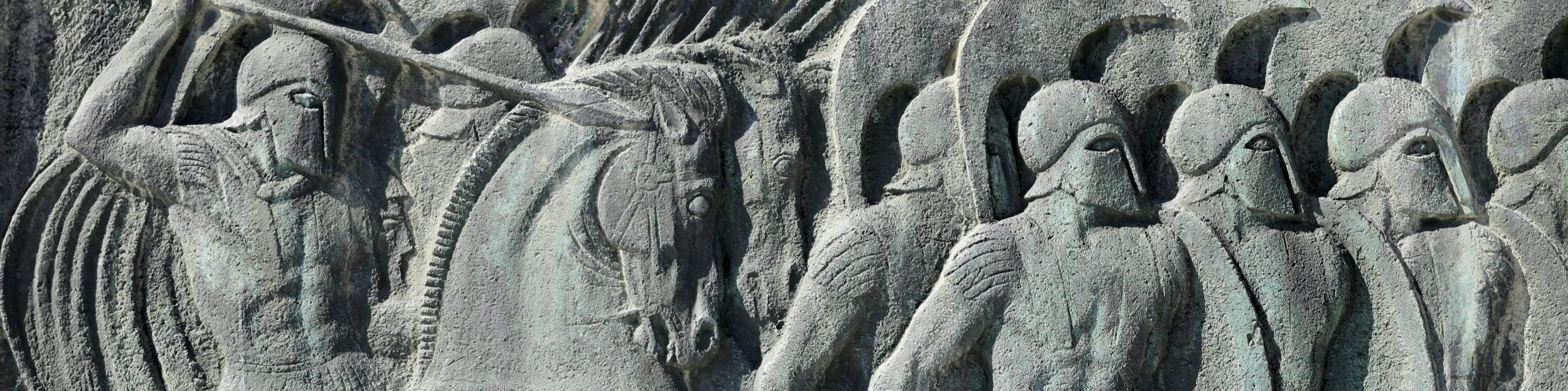
The late Maj Gen (R) William Mullen was famous for popularizing what he coined the 5,000-year-old mind—the idea that through professional reading and deeply reflecting upon warfare throughout history, modern-day warriors can develop the ability to out-think the enemy through absorbing the accumulated wisdom and experiences of human history into their own schema. Unfortunately, there is never enough time for one to read and reflect upon everything one might wish to. Not all texts are created equally, and everyone is busy. Simply put, not everything is worth reading.
When looking back across 5,000 years of lessons learned, one must consider how far is too far back to look. Indeed, air battle managers should rightly question whether history prior to the advent of airpower holds relevance for them or not. Upon consideration, even ancient history can offer valuable insights for practical use. One such example is the Battle of Marathon in 490 BC, which demonstrates how principles from pre-airpower history can enable present-day air battle managers to leverage enduring truths to develop a more comprehensive framework for modern-day command and control.
The sun beat his back as the open plain of Northeastern Attica stretched before him. Marathon. Just yesterday he had argued with his fellow generals as to whether to wait for the Persians to attack or to strike first. It was decided to attack.
Miltiades knew the odds were not in his favor. 15,000 Persians against his 10,000 Athenians and 1,000 Plataeans. Outnumbered.
He also knew that although heavily armored, his hoplites would stand no chance against the Persian cavalry. His only hope was that the unfavorable terrain would even some of the odds. Outmatched.
The Persian archers also held the firepower advantage with a composite bow that granted superior range and power to that of his forces. Outclassed.
But today was different. Miltiades had received word the Persian cavalry was not present. Although the Persians still held the numeric advantage, his attack would surely benefit from the cavalry’s absence. Granted, the Persian bow would still prove challenging, but if his forces could close the distance quickly enough, their spears and superior tactics could carry the day…
Ancient warfare has been described in many ways, but imaginative is not usually an adjective affixed to ancient combat. As Montross notes in War Through the Ages, ancient armies essentially smashed into each other until one side either died or capitulated, eventually maturing to line-and-column tactics seeking to envelope an enemy force.
Miltiades seemed to possess uncommon awareness of these realities and knew how to exploit them. According to Montross, Miltiades may have been the first in recorded history to leverage nature as a force multiplier, anchoring his flanks against marsh on one side and foothills on the other—allowing the terrain itself to provide an effect he could not achieve with the numbers he had. With his flanks effectively secured by the terrain itself, he increased the width of his line to combat a numerically superior adversary at the expense of thinning his center. Moreover, the terrain gave Miltiades one final advantage: the ability to run downhill, thus allowing him to actualize his desire for quickly closing the gap between his forces and the Persian forces.
The result was slaughter on a scale the Athenians and their Plataean allies could not have imagined. Attacking the downward slope at a sprint, Miltiades’ forces quickly arrived at the Persian line, inducing shock and chaos by closing the distance before the Persian forces had time to recover. Further, as Montross aptly observes, whether by Miltiades’ own design or by pure luck, the Persian strength was directed toward the Athenian’s weakened center, forcing his center forces back and allowing the reinforced flanks to now naturally turn inward, encircling the Persian forces in a double-envelopment that is still celebrated and studied today.
Covered in blood and sweat, Miltiades was a victor. 6,400 Persians lay dead before him at the cost of 192 of his own Athenians and 11 Plataeans. Athens would need to learn of this quickly to capitalize. Turning to the messenger Pheidippides (whose fate would enshrine the endurance of the memory of Marathon in popular culture), the message to relay was simple: Rejoice! We have won!
Departing from the narrative of Miltiades’ victory, does his tale offer merely an inspiring example of victory that rightly assumes prominence in the annals of ancient warfare or does it offer something more? Can Miltiades impart any enduring truths sufficiently practical for modern use? Can he offer any insight into the current situation: how to best a rival possessing overmatch in both numbers and capabilities?
Use What Is Available Effectively
Miltiades could not change the reality of his situation: his enemy had overmatch in every meaningful military category. So, he used what he had effectively—in his case, terrain. Skillful use of terrain allowed Miltiades to give his forces advantages and to erode those of his foes.
Although the Department of the Air Force (DAF) is hard at work developing impressive capabilities to grant advantages in peer-to-peer conflict, these capabilities take time to develop and may not be available when needed. Further, the current fiscal landscape and the realities of having to balance the often-competing factors of cost, schedule, and performance present an uncomfortable prospect: some of these capabilities may not be able to do everything once envisioned. So, current capabilities must be maximized. What current capabilities are available now and how are they used most effectively? Although there is interest in E-7 acquisition efforts amongst air battle managers currently employing the E-3 AWACS, they must hone their skills and expertise in the platform currently fielded until more advanced capabilities become available—understanding the implications of program delays and other barriers that prevent such advanced capabilities from being immediately available to warfighters. Likewise, although the ambitious DAF battle network promises hope for the future, air battle managers executing from control and reporting centers and battle control centers will need to continue working through innovative solutions to navigate the limitations inherent in ground-based command and control systems while battle managing across a massive area of operations until the vision for the DAF battle network becomes reality.
The Need for Force-multipliers
Miltiades was outnumbered and knew it. However, he was able to draw upon the fact that Greek city-states were almost always outnumbered. So, (as Montross notes) the city-states evened the odds by learning to fight better, becoming brilliant strategists and tacticians by necessity. In an era when armies were still heavily dependent upon pure mass/numbers to overwhelm rival armies, the Greeks developed martial prowess and fighting skill—essentially mitigating numerical advantage by allowing one Greek to be the equal of two or three enemy soldiers.
In an era where emerging peers of the US may possess numerical superiority and better capabilities, work must be done to erode the advantages this superiority offers by cementing a US edge. If US rivals struggle to conduct joint operations, can American joint integration erode the advantages offered by more advanced capabilities and where can airpower play a role in this? If US rivals struggle to seize the initiative or exercise mission command, can Airmen control the tempo of battle by being experts in these skillsets? Indeed, datalinks and cloud-based data sharing capabilities offer present-day air battle managers the opportunity to convert information and data to decisions and actions at a speed and scale never-before seen—securing decision-advantage against peer adversaries.
The Importance of Speed
Miltiades mitigated any advantage superior firepower could have offered the Persians by quickly closing the distance, driving hand-to-hand combat on his terms while his adversary still had not even effectively worked through why their arrows were ineffective and adapted accordingly.
Speed remains paramount in modern warfare and possessing the capabilities required to enable speed (of mobility, decision, etc.) rightfully remains an obsession for the DAF. At its core, speed grants a force the ability to control the tempo of a conflict and drive an adversary into reaction—what has popularly been coined getting inside the adversary’s OODA loop. Although Airmen are unlikely to find themselves charging downhill into an ancient Persian horde, there are several implications from Miltiades’ experience: (1) speed is not an end unto itself; speed is a means to achieve a goal; (2) do Airmen understand the target and the integration of effects across multiple domains to achieve an effect against that target at a time and place of one’s choosing?; and (3) once a speed advantage is achieved, how is it maintained?—or will modern day Airmen join Napoleon’s invasion of Russia and Germany’s Ardennes Offensive as yet another historical example of a force that started off strong but ultimately failed to achieve its objectives due to early culmination?
Make the Enemy Complicit in Its Own Destruction
The Persian force was culpable in its own defeat. It went for the weakened center that allowed the reinforced Athenian/Plataean flanks to encircle it. Moreover, Miltiades positioned himself at the center, perhaps further enticing the Persian forces toward the center and ultimately their own destruction.
Airmen have been known to make the statement, “[insert action] will make the enemy do [insert action].” Misguided enthusiasm or hubris notwithstanding, one cannot make someone else do anything—at best one can simply influence and encourage someone else toward a decision. However, this does not mean DAF operations, activities, and investments cannot help shape rivals’ pursuits. Is the US purposefully trying to steer rivals in a direction preferable to its interests? Or simply reacting? Is the US perpetuating its own self-critiques regarding its tendencies to want to fight the last war or to fight the war it wants to fight rather than the one currently engaged?
Leadership Matters
Miltiades rises in present conscious as a mythic figure in a near-folkloric battle. A leader to emulate. He was able to accurately assess the strengths and weaknesses of his force, the enemy force, and his environment to achieve a victory that should not have been his. Moreover, Miltiades positioned himself in the middle of his formation—the very center he had intentionally weakened. Perhaps his positioning may have been to further encourage the Persian force to take the bait and direct efforts toward the center. However, (at the risk of romanticizing a historical figure with no actual evidence for this assertion) his reasoning may also have been to inspire his forces: to not ask the forces at the intentionally weakened center to do something he was not willing to do himself.
Miltiades’ example invites present-day air battle managers to strive to become the leaders Airmen need them to be. It also challenges them to self-reflect upon how they approach challenging circumstances: do they surrender to the cynicism prevalent around them or do they find opportunity and seize it?
Conclusion
Thus, careful and purposeful study of the Battle of Marathon proves pre-airpower history can provide valuable insights for present-day air battle managers. Admittedly, there are limitations in applying Miltiades’ experience to the present and the lessons he learned are not entirely portable to the current context. The myth of Icarus notwithstanding, the concept of Airmen was as foreign to Miltiades as many of his realities would be to present-day air battle mangers. Yet, when critically thinking through the parallels—seeking to actively learn from the past—careful study of Miltiades’ experiences forces present-day air battle managers to think critically about how they can fight and win their own wars. And that is something worth learning more about. Since, the history of warfare can better prepare modern warriors for their own battles, present-day air battle managers should not limit themselves to the study of only airpower history; rather, they should approach all the lessons history affords with an open mind and should embrace these lessons as a means to enhance their lethality.
The views expressed are those of the author and do not reflect the official policy or position of the U.S. Air Force, Department of Defense, or U.S. government.
Photo by GreekEditor Studios on Pexels

Leave a Reply