
Introduction
The Problem
Legacy airborne command and control platforms lack capability and capacity, a problem that has long existed and is only getting worse as the U.S. Air Force continues to divest the E-3 AWACS, its sole airborne command and control, air battle management (C2ABM) asset. Recognizing that the People’s Republic of China is rapidly improving its military and is on track to be prepared to achieve a forced unification of Taiwan between 2027 and 2030, the U.S. Air force has begun efforts to modernize this force through the acquisition of E-7 airborne early warning and control (AEW&C) aircraft; however, these efforts were on track to be delivered late-to-need, at enormous cost, and in insufficient numbers. This modernization effort is now in jeopardy, as the Department of Defense has indicated its desire to cancel the E-7 program in light of these concerns.
Recent proposals to field space-based systems as the sole capability to mitigate the E-7’s cancellation are aspirational, as the technology is not yet mature, and are insufficient, as these proposals fail to provide resilience against modern threats. Further, such proposals fail to consider an air battle management layer, and instead are focused solely on the production of air moving target indicator (AMTI) sensor data. While space-based sensors may enhance future air battle management capabilities, they should not be relied upon to replace them. An airborne C2ABM element is still required.
There are still viable paths forward for the E-7 program to be continued, but these paths are far from certain. Air dominance advocates have been active in arguing for the merits of the E-7 program, and tend to style the E-7 program as indispensable – the only viable path forward for large-scale air battle management and tactical command and control of air operations. The advantages of the E-7 are clear; however, with the program now at risk, it is prudent to consider other alternatives that could provide the required effects in a flexible and resilient manner without running afoul of the Department of Defense’s concerns regarding cost, survivability (or risk), and delivery timelines.
When considering these alternatives, C2ABM advocates and practitioners should think beyond simply replacing the E-3 with a modern equivalent and instead should fully consider how airborne battle management effects might best be delivered in modern conflict. Doing so may prepare key advocates to immediately recommend, nay demand, another alternative that might inspire greater Department-level support should the E-7 program be terminated as planned. This article is intended to serve as the opening salvo for the consideration of alternative options to enable this outcome.
The Solution
Airborne C2ABM remains relevant in modern conflict. To adapt to the U.S. Air Force’s agile combat employment (ACE) concept, future airborne command and control forces should be distributed, resilient, and capable of operating within an acceptable level of risk (ALR) while delivering desired effects. This may be achieved by employing command and control platforms not as individual platforms, but instead as airborne packages or formations. These command and control packages should be employed in a manner that enables task-sharing and task assumption under a primary, alternate, contingency, and emergency (PACE) model of responsibilities, while also enabling dynamic risk management with the option to “surge” individual elements of each package into positions of maximum effect and higher risk when required to support the mission. Such a concept of employment must be underpinned by a sufficient mass of command and control aircraft, each with minimal crew and sustainment requirements.
Employ
Agile Combat Employment (ACE)
The future of U.S. Air Force employment is guided by the operational concept of ACE, and this article will use this operational concept as the service-wide baseline to use when considering the details of how airborne C2ABM should be employed. To employ under the ACE model, airborne C2ABM must operate in a manner that is distributed, redundant and resilient, and capable of surviving while delivering desired effects.
Distributed
Airborne C2ABM must employ as a distributed force, capable of maneuvering and dispersing across the theater. Maneuver includes the “expansion of operational footprints and access throughout the theater,” while dispersal is critical to ACE as it “complicate[s] enemy targeting by either redistributing forces to multiple operating locations or redistributing forces within an established air base.” Large C2ABM aircraft such as the E-3 and E-7 are not capable of truly employing in a distributed manner as the small fleet size limits the ability to expand across the theater; the large sizes of both the aircraft and crews preclude operations and bed-downs at true bare bases; and, specific to legacy platforms, the decaying airframes often require repairs that can only be accomplished at sites with significant maintenance infrastructure. Future airborne C2ABM platforms, crew compliments, and sustainment packages must be sufficiently small to allow for operations from myriad distributed locations separated from major logistical and support hubs, and must be fielded in sufficient mass to enable expansion of the airborne C2ABM footprint across a theater to employ under ACE.
Redundant and Resilient
ACE doctrine notes that C2ABM capabilities in the theater must be redundant and resilient. In the Pacific theater, where ground- and sea-based C2 face significant limitations due to vast distances, airborne C2ABM must be redundant and resilient to itself to enable ACE in the Pacific. Legacy airborne C2ABM platforms are largely incapable of employing in a redundant and resilient manner, as they are few in number and too old to rapidly turn from mission to mission. This minimizes opportunities for legacy platforms to employ together to offer redundancy or resiliency if one platform is unable to complete its mission due to malfunction or attrition. Future airborne C2ABM platforms must be reliable and employable in sufficient numbers to enable multiple platforms to operate near one another simultaneously, and their crews must be capable of taking on critical roles once held by sister crews that are unable to fully execute their mission for whatever reason. These redundant and resilient airborne C2ABM packages should employ together, dividing tasks across independent aircraft and considering PACE fallback responsibilities for each aircraft as other aircraft within the C2ABM package are rendered unable to continue their missions. Such an employment concept enables “graceful degradation” of airborne C2ABM throughout an operation as individual units are removed from the battlespace, and prevents any single C2ABM platform from becoming a critical single point of failure for an entire mission or even for an entire air tasking order (ATO) day.
Mass Effects
The ACE operational concept notes that ACE is designed to enable the Air Force to “mass fires to achieve convergence of effects in all domains.” In other words, ACE exists to enable Air Force platforms to deliver their required effects. As such, airborne C2ABM assets must employ in a manner that enables them to provide required effects and, as an implied task, survive long enough to do so for as long as the conflict requires. Achieving this requires C2ABM units to operate within a tactically-relevant proximity of relevant friendly and/or adversary forces while also operating within their assigned acceptable level of risk. Legacy airborne C2ABM platforms may struggle to find this balance during a peer-level conflict, as decades-old sensors may become increasingly challenged to detect adversaries at sufficient ranges to ensure platform survival. Doing so without support from defensive platforms may be impossible under a low or moderate ALR. This problem may be mitigated in one of two undesirable ways: defensive assets must be assigned to protect the airborne C2ABM platforms, or a higher level of risk must be accepted. In the former instance, valuable resources including fuel, weapons, and sensors must be pulled away from contributing to other combat functions. In the latter, a significant risk to mission may be incurred over the duration of the conflict as limited numbers legacy C2ABM platforms become even more scarce with each loss. To overcome this, future airborne C2ABM platforms should be employed in sufficient mass to enable commanders to temporarily accept elevated levels of risk to individual C2ABM platforms while minimizing overall mission risk for the duration of the conflict. This can be done by employing a redundant and resilient airborne C2ABM package in a manner that allows individual aircraft to temporarily maneuver into a position of elevated risk to provide required effects during critical periods –“surge” or “pulse” may be catchy phrases to describe such maneuvers– while leaving other aircraft in the package in positions of lower risk unless/until required to fulfill their PACE responsibilities.
Putting it Together
Airborne C2ABM will play an important role in any modern conflict, and will be best postured to do so if adapted to the Air Force’s ACE concept. As such, airborne C2ABM must be distributed, redundant and resilient, and capable of remaining within the ALR while delivering desired effects. This may be achieved by employing airborne C2ABM not as individual platforms, but instead as airborne C2ABM packages or formations. These C2ABM packages should employ in a manner that enables task-sharing and task assumption under a PACE model of responsibilities, and enables flexible and acceptable risk management by “surging” individual elements of each package into positions of maximum effect and higher risk when required to support the mission. Such a concept of employment must be underpinned by a significant mass of airborne C2ABM platforms, each with minimal crew and sustainment requirements.
Equipping the Force
To enable combatant commanders to employ a relevant airborne command and control force against a modern threat, the U.S. Air Force should equip itself with a sizable fleet of platforms and aircrews capable of operating from austere bases, as described above. To achieve this, the U.S. Air Force should field large numbers of small and relatively inexpensive aircraft that are capable, though imperfect. To achieve this within a relevant timeframe to support certain potential conflicts in the Pacific, the U.S. Air Force should adopt novel acquisitions and contracting strategies to rapidly field the required force.
Massive Fleet, Small Airframes
A principal challenge with the U.S. Air Force’s legacy airborne command and control platform, the E-3, is limited quantity. The Air Force maintained 31 E-3s for decades until divestment began in FY2023. This was not a sufficient number of aircraft to satisfy all combatant command requests, even during low-intensity conflicts, and resulted in the E-3 being considered a high-demand/low-density asset. Termed another way, the E-3 did not afford sufficient mass for the airborne command and control mission. Fielding a replacement platform in sufficient mass to solve this problem should be a top priority, as failing to do so all but ensures that some combatant command requirements will go unmet, drives a low acceptable level of risk for each platform, reduces the possibility for redundancy in or “graceful degradation” of airborne command and control during conflict, and generally limits the flexibility and utility of airborne command and control.
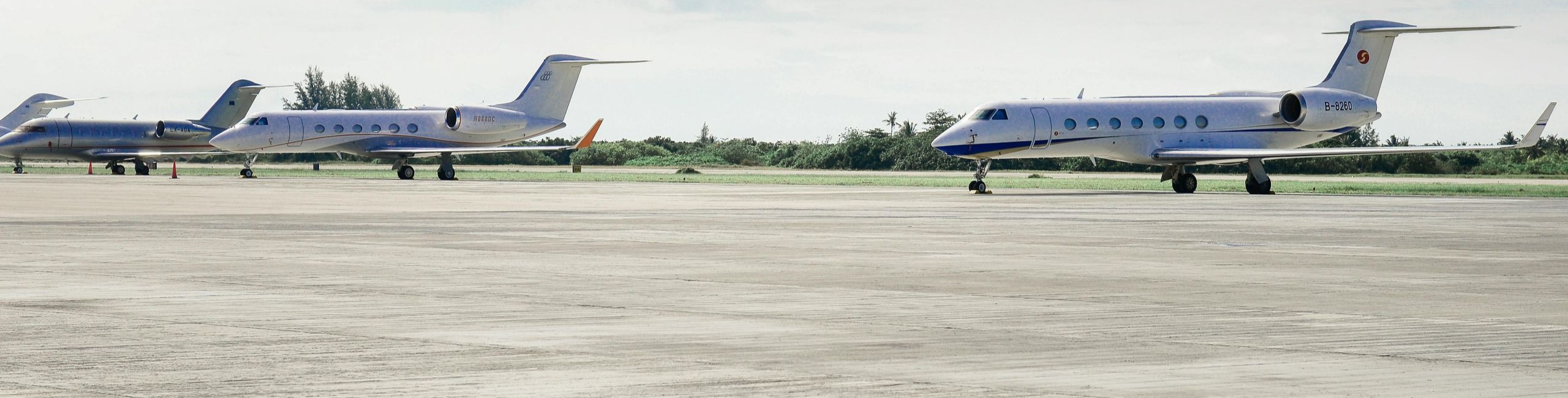
To achieve mass and flexibility, the U.S. Air Force should equip itself with modern aircraft that are significantly smaller than the legacy E-3, both in terms of aircraft size and crew complement. Smaller airframes, such as the Gulfstream G550 or Bombardier Global 6000/6500, will enable the platform to operate from a larger variety of airbases, as smaller aircraft generally require shorter runways and less-improved taxi and parking surfaces than their larger counterparts, while smaller crews require less infrastructure and equipment to sustain them once established at an airbase. Together, these advantages will enhance the ability of the C2ABM force to disperse and survive under the agile combat employment concept. Smaller crew complements also enable more crews to be created from the same number of personnel, which enables larger numbers of trained aircrews to operate the larger fleet of C2ABM aircraft that will be required in future conflicts.
Low Cost-per-Unit
In addition to ensuring that future-equipped command and control aircraft are small in terms of size and crew complement, the U.S. Air Force should focus on fielding aircraft that are relatively inexpensive per-unit. A low per-unit cost will enable meaningful quantities of a newly selected platform to be procured at the start, and also improves the program’s resistance to appropriations cuts borne of constrained resources or program fatigue. Achieving this goal will require ruthless prioritization of required capabilities – requirement creep or project bloat must be resisted. Any capability not strictly required for success in future conflict should not be pursued, as the cost incurred will reduce the likelihood that the platform can be procured in sufficient mass. Not-strictly-required capabilities may include capabilities that exist in legacy or contemporary command and control aircraft, such as 360-degree radar coverage, which may be mitigated by well-designed flight paths and/or multi-ship employment, or aerial refueling capability, which may be mitigated by long-range/high-speed airframes capable of remaining airborne for 11–18 hours unrefueled. Further, procuring like airframes to already-fielded Air Force or Army aircraft with similar mission sets may additionally facilitate a lower cost, as this prevents the need to maintain production lines for a new airframes and streamlines logistics and sustainment efforts over the lifetime of the platform.
Rapid Fielding
The U.S. Air Force should pursue a novel strategy to become properly equipped during the critical period, as even a brilliant aircraft acquisitions strategy takes years to deliver a prototype and far longer to achieve procurement at scale. The Department of Defense’s plan to leverage the U.S. Navy’s existing E-2D procurement effort, capable of delivering 5-6 aircraft per year starting immediately, is one possible start, though the E-2D is ill-suited to the Air Force’s mission of providing theater-level tactical command and control. Alternatively, the U.S. Air Force could work with U.S. defense contractors, such as L3Harris, that have produced smaller, yet capable, airborne C2ABM platforms for and with foreign partners. These contractors have ready-made designs and recent production experience that could bypass entire segments of the typical acquisitions process to enable rapid delivery of future platforms at scale.
Other available options include temporarily bypassing the acquisitions process altogether and temporarily adopting a contracted “as-a-service” approach. Enterprising contractors could rapidly procure or modify aircraft and could hire separated air battle managers or E-2 naval flight officers to provide required air battle management effects as-a-service during training and conflict. Contractors unencumbered by requirements to “buy American” could build their fleets with new or used aircraft produced by or for allies, such as Israeli-made Gulfstream 550-based Conformal Airborne Early Warning (CAEW) aircraft or any number of offerings based on Saab’s GlobalEye system. To provide a trained workforce to employ this fleet, the U.S. Air Force could pursue a contractor-owned, government-operated model in which the U.S. Air Force would effectively lease C2ABM aircraft from providers, or the U.S. Air Force could implement a voluntary separation program (VSP) for air battle managers that could be hired by contractors tasked to own and operate the fleet. This as-a-service approach could be scaled over time to “fill the gap” left by the lack of organic command and control aircraft while the U.S. Air Force energizes a more traditional long-term acquisitions strategy that more adeptly meets its long-term needs, and could contract (pun intended) as the U.S. Air Force accepts delivery of organically-owned modern airborne command and control systems at scale.
Conclusion
The U.S. Air Force may soon be forced to reexamine its efforts to modernize its airborne command and control enterprise, and should do so in a more thoughtful manner than simply replacing one large aircraft, large crew, high-demand/low-density platform with another. The procurement of a large fleet of small, relatively inexpensive command and control aircraft, such as a G550-based CAEW or a US variant of the GlobalEye, would enable the U.S. Air Force to apply the principle of mass to its C2ABM force, would enable C2ABM employment in accordance with the ACE concept, and would provide combatant commanders with increased flexibility to employ and accept necessary risk with airborne C2 platforms during conflict. There are many courses of action that could be pursued to this end, and, should the E-7 program be cancelled, it is of the utmost importance that one of these be selected and aggressively implemented to enable the fielding of a modern C2ABM force within a relevant timeframe.
Photo by Asad Photo Maldives on Pexel
The views expressed are those of the author and do not reflect the official policy or position of the U.S. Air Force, Department of Defense, or U.S. government.
Leave a Reply