
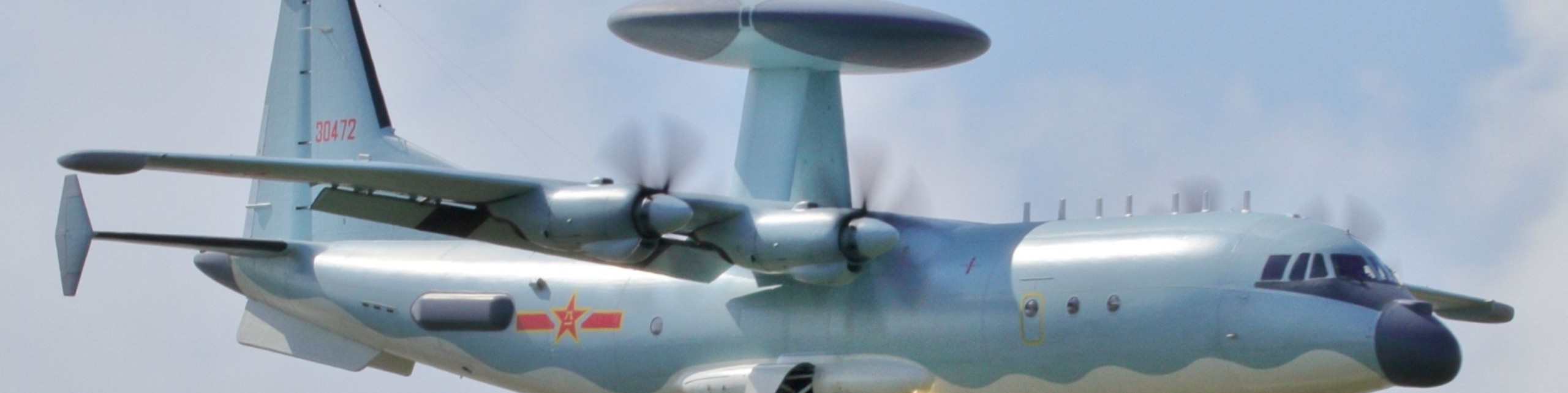
For decades, “Blue” air forces enjoyed a “permissive” environment where air superiority was assumed. But as the Mitchell Institute for Aerospace Studies warns, that era has ended. We are no longer in a world of lone-wolf dogfights; we are in a world of network-centric warfare. The most dangerous threat in the sky today isn’t necessarily the fighter on your nose; it’s the Shaanxi KJ-500 orbiting 400 kilometers away, silently orchestrating your demise.
The Shaanxi KJ-500 acts as the PLAAF’s all-seeing eye, rewrites the PLAAF’s air dominance tactics, expands the PLAAF’s reach, and mitigates some of the West’s historic advantages including stealth and decision superiority. Understanding these advantages can enable “blue” forces to effectively counter them, retaining an advantage in the Pacific.
The All-Seeing Eye of the PLAAF
The Shaanxi KJ-500 is not just an airborne radar; it is the central nervous system of the People’s Liberation Army Air Force (PLAAF). Developed by the Shaanxi Aircraft Corporation, it represents the culmination of thirty years of Chinese military observation. After witnessing the resounding success of Operation Desert Storm in 1991, Beijing realized that whoever controls the data controls the sky.
The KJ-500 is built on the Y-9 turboprop airframe, a choice that prioritizes loitering endurance over raw speed. While Western systems like the aging E-3 Sentry rely on heavy, maintenance-intensive jet engines, the KJ-500 utilizes four WJ-6C turboprop engines with six-bladed propellers. This allows the platform to remain on station for up to 12 hours, providing a persistent “Silicon Canopy” over contested airspace. But the real threat is the saucer-shaped radome on its back. Unlike the mechanical, rotating “rotodomes” of the past, the KJ-500 features a fixed tri-array AESA radar. This three-sided Active Electronically Scanned Array provides uninterrupted 360-degree coverage. Because the radar beam is steered electronically rather than mechanically, there is no “blink,” the time it takes for a traditional radar dish to rotate back to a target. This results in a faster target revisit rate, which is critical for tracking high-speed cruise missiles and stealth fighters like the F-22 and F-35.
China is currently producing more flying radar systems than the rest of the world combined. With over 60 airframes already in service across the PLAAF and the Naval Air Force (PLANAF), Beijing is building a dense, redundant network of airborne command nodes that can support numerous large-scale air operations simultaneously.
The Silent Shooter: Rewriting the Rules of Engagement
The KJ-500’s most lethal contribution to the modern battlefield is its enablement of “silent shooter” tactics. In traditional air combat, a fighter must turn on its own radar to find and lock onto a target. However, doing so acts like a flashlight in a dark room; it reveals the fighter’s position to the enemy’s Electronic Support Measures (ESM).
Under the “silent shooter” doctrine, a fifth-generation fighter like the Chengdu J-20 can operate under strict radar silence (EMCON). The KJ-500, sitting safely in a protected orbit, “paints” the sky and streams real-time targeting data directly to the J-20 via high-bandwidth datalinks. This allows the J-20 to navigate, position itself, and launch ultra-long-range missiles like the PL-15 or the record-breaking PL-17 without ever emitting a signal.
The result is a compressed kill chain that catches Blue Force airmen off guard. By the time a Western pilot realizes they are being tracked, a missile, guided mid-course by the KJ-500, is already in its terminal phase. According to some operational assessments, this synchronized “kill web” increases interception efficiency by 15 to 30 times compared to isolated platforms.
Strategic Reach: From the South China Sea to the Himalayas
The KJ-500 is the linchpin of China’s Anti-Access/Area-Denial (A2/AD) strategy. By deploying these assets to island outposts like Fiery Cross Reef and Subi Reef, China has extended its radar horizon deep into the South China Sea. A KJ-500 orbiting these outposts can sense high-flying targets out to 388 nautical miles, providing a protective umbrella for Chinese carrier groups and maritime strike aircraft.
This capability is also being exported, fundamentally shifting regional power balances. Pakistan’s impending acquisition of the KJ-500 is poised to tip the scales against India. By linking its J-35A fighters and HQ-19 missile defenses into a unified Chinese-designed network, Pakistan can identify Indian aircraft far earlier and coordinate its forces with an information advantage that offsets India’s numerical superiority.
The evolution hasn’t stopped. The introduction of the KJ-500A variant, equipped with an aerial refueling probe, means these “flying radars” are no longer limited by fuel lines. Compatible with YY-20 tankers, a KJ-500A can remain airborne until the crew’s fatigue becomes the primary limitation, making it a near-permanent fixture in any future crisis.

Tactical Capability Assessment: KJ-500 vs. Blue Force Air Supremacy
This tactical assessment provides a granular look at how this platform specifically dismantles the historical pillars of Western air dominance. To survive the Indo-Pacific “Silicon Canopy,” Blue Force airmen must understand that the KJ-500 is not just a sensor; it is a tactical disruptor designed to minimize the advantages of “stealth” and turn decision-making into a race against a compressed clock.
Stripping the Stealth Cloak
The most significant tactical challenge for U.S. fifth-generation fighters like the F-22 and F-35 is the fixed tri-array AESA radar of the KJ-500. Traditional airborne radars rely on a mechanically rotating dish that creates a “blink” or refresh lag as it spins. The KJ-500’s three separate active arrays provide uninterrupted 360-degree coverage, allowing for an incredibly fast target revisit rate. This electronic beam steering is optimized to detect low-Radar Cross Section (RCS) targets by maintaining continuous tracking energy on a specific sector, effectively providing high-fidelity data to cue long-range interceptors or surface-to-air missile systems directly toward stealth vectors.
Execution of the “Silent Shooter” Kill Web
In a tactical engagement, the KJ-500 serves as the primary C4ISR node, enabling what is known as “silent shooter” tactics. Blue Force Electronic Support Measures (ESM) typically rely on detecting a fighter’s active radar emissions to locate them. However, platforms like the Chengdu J-20 can now operate under strict radar silence (EMCON). The KJ-500 “paints” the sky from a protected distance and streams real-time engagement cues directly to the fighters via high-bandwidth datalinks. This allows the “silent shooter” to navigate and launch long-range missiles such as the PL-15 or PL-17 without ever activating their own sensors, leaving Blue Force targets with zero electronic warning that an engagement is underway.
Short-Circuiting the OODA Loop
Tactical survival depends on the OODA loop (Observe, Orient, Decide, Act). The KJ-500 integrates data from ground radars, naval sensors, and UAVs into a fused operational picture, acting as a central node that reduces the time between detection and engagement. This synchronization reportedly increases interception efficiency by 15 to 30 times compared to isolated platforms. For a Blue Force battle manager, this means the reaction window to counter an incoming strike is drastically reduced, as the KJ-500 can simultaneously track between 60 and 100 targets within a 470-kilometer radius, saturating the battlespace with coordinated threats.
Deep Theater Reach and Resilience
The deployment of the KJ-500 from island outposts like Fiery Cross Reef provides persistent tactical coverage deep into the First Island Chain. From these forward locations, a single KJ-500 can observe high-flying targets out to 388 nautical miles, effectively pushing the sensor umbrella into what were once considered safe corridors for Blue Force tankers and command aircraft. Furthermore, the KJ-500A variant, featuring an aerial refueling probe, ensures that this “Eye of the Dragon” stays on station as a near-permanent fixture, making tactical surprise via timing almost impossible for Blue Force planners.
How Blue Force Reclaims the Sky
To counter the KJ-500 ecosystem, the United States and its allies must move beyond assumed air superiority and embrace temporal air superiority: controlling the air at a specific time and place to achieve a mission objective.
- “Kill the Kill Chain”: Our primary focus must be severing the links between the KJ-500 and its shooters. This involves aggressive electronic warfare, cyber-disruption of high-bandwidth datalinks, and the use of long-range anti-radiation weapons to force the KJ-500 to go “dark” or retreat.
- Agile Combat Employment (ACE): We must move away from a few large, vulnerable bases. By utilizing dispersed and defended island airstrips like Tinian and working with Compact of Free Association (COFA) nations, we can complicate China’s targeting cycles. These distributed locations must be outfitted with their own modernized ground radars like the 3DELRR to ensure a resilient surveillance web.
- Modernize the Battle Management Fleet: The retirement of the E-8 JSTARS and the obsolescence of the E-3 Sentry have left a dangerous capability gap. We must accelerate the acquisition of the E-7 Wedgetail. The E-7’s MESA radar provides the AESA capability we need to match the KJ-500’s detection revisit rates.
- Layered Multi-Domain Sensing: We cannot rely solely on space-based sensors, which are vulnerable to anti-satellite (ASAT) weapons and jamming. A robust defense requires a layered approach, combining space, high-altitude air platforms, and ground-based MTI, to provide a redundant and resilient common operational picture.
Tactical Conclusion for Airmen
The KJ-500 is the primary enabler of a connected “kill web” that offsets Western numerical and technological advantages. Blue Forces must prioritize killing the kill chain by targeting the KJ-500 through electronic warfare, long-range anti-radiation weapons, or Agile Combat Employment (ACE) to force the network to degrade. If the KJ-500 node is removed, the “silent shooters” are effectively blinded, restoring the tactical parity needed to reclaim the skies.
Modern air combat is no longer about who has the fastest jet; it’s about who has the most resilient network. The KJ-500 has effectively ended the era of the “Lone Wolf.” To win in the Indo-Pacific, Blue Force airmen must learn to operate under the constant gaze of the Dragon’s Eye and master the art of Air Battle Management to tear that network apart.
Check your EMCON, watch your six, and fly safe.
References and further reading on the KJ-500:
KJ-500 Technical Data (Mitchell Institute)
The Evolution of the Chinese Kill Web (Defence Security Asia)
China’s Massive Production Scale (Military Watch Magazine)
The Urgent Case for Air Battle Management Modernization (Mitchell Forum PDF)
Ernesto “Nacho” Nisperos is currently a systems architect and Battle Management SME in the DAF Integrated Fires Command and Control PMO. He also runs a non-profit and several projects supporting military families. His latest project is a weekly OSINT threat assessment on the militaries most prominent adversary weapons systems. Chucks and Ducks can be found on his LinkedIn and YouTube channel @chucksandducks.
The views expressed are those of the author and do not reflect the official policy or position of the U.S. Air Force, Department of Defense, or U.S. government.
Leave a Reply