
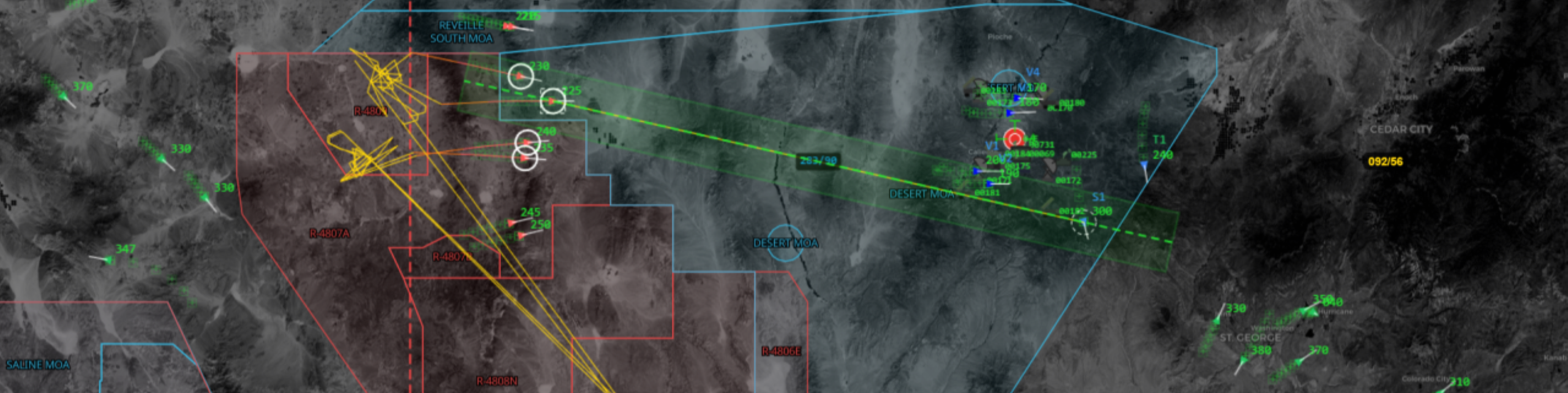
Simulation has always been one of the Air Battle Management enterprise’s most important training tools. In Just Like in the Simulations, David “Solo” Blessman argues that simulation training gives C2ABM professionals a way to develop Information Management and Force Management skills across 100-, 200-, 300-, and 400-level events. That framework is useful because it treats simulation as more than a place to rehearse a script. It treats simulation as a progression: fundamentals, coordination, advanced integration, and eventually the ability to guide others.
The next question is how new technology, including AI, can help train the next generation of C2ABM operators.
We get there by attacking the limiting factors that hold training back: sim time, physical space, instructor availability, sim drivers, scenario development, and the number of useful repetitions an operator can get before a major event.
Many C2 operators have seen the same training pattern: a weekly or every-other-week simulator event, if they are lucky, with limited scenario variation, a small pool of available instructors, and a large amount of support required before the first training objective is even exercised. Those events still matter. They provide structure, standards, crew coordination, and a shared learning environment. Scheduled simulator events are not the problem. Their scarcity is.
At some point, repetition can turn into recognition. The flow becomes familiar. The injects become predictable. The training audience may still improve, but the event itself can stop forcing new decisions. That is not a failure of simulation. It is a sign that the community needs more varied and more accessible repetitions between major training events like Red Flag, so we can extract more value from each level of progression.
The future of C2 training should include that missing middle layer: a way to build frequent, mission-relevant reps before operators consume scarce high-end simulator time.
The Training-Throughput Problem
C2 training is labor-intensive because C2 itself is relational. A student or crew rarely trains alone. Someone must manage the scenario, move tracks, create friction, role-play fighters or outside agencies, generate adversary reactions, handle voice traffic, and decide when an inject helps or distracts from the objective. That human support is often provided by the same experienced operators and instructors who are also needed for the real mission, upgrade training, evaluations, planning, and daily unit requirements.
The result is a training throughput problem.
A unit may know exactly what its students need: more check-ins, more comm checks, more airspace deconfliction, more tanker coordination, more picture calls, more threat calls, more tactical updates, more recovery from mistakes, and more repetition under time pressure. Knowing the need does not automatically create the manpower, simulator time, or white-force support required to meet it.
That matters because the early repetitions shape everything that follows. A student who gets only a handful of reps before a more advanced event will often spend valuable time focusing on not messing up the picture call or missing a range call. A student who gets a hundred quality reps before the same event can spend that time making higher-order air battle management decisions.
High-end simulation remains essential. Large, instructor-led, distributed, and joint events are not the target for replacement. They are the reason the community should build better preparation before operators consume scarce simulator time.
AI as a Repetition Layer
An impactful role for AI in C2 training is to create more repetitions inside instructor- and unit-approved constraints.
An AI-assisted simulator could instantly generate scenario variations from parameters set by the training team. It could move friendly and adversary tracks, vary timing, create degraded communications, simulate basic tactical reactions, provide voice responses from simulated players or agencies, and introduce friction without requiring a full team of sim drivers for every basic event.
It could also tag key moments for debrief: missed calls, late updates, poor prioritization, or decisions that created downstream effects. At a basic level, it could help students identify areas for improvement before an instructor administers the final assessment.
This does not remove the instructor from the loop. It changes where instructors spend their time.
Instead of manually driving every entity, reading scripted lines, or rebuilding minor scenario variations, instructors and sim drivers could spend more time setting standards, defining the training objective, aligning training scenarios with evolving regional threats and command priorities, reviewing performance, correcting habits, and deciding when the student is ready for greater complexity.
That distinction matters. AI should not be treated as a tactical authority or a source of certification. It should be treated as a tool for repetition, variation, and feedback inside boundaries set by the training community. The instructor remains responsible for standards. The unit remains responsible for relevance. The human team remains responsible for judgment.
Guardrails Matter
The C2 community should be optimistic about AI-assisted simulation, but not careless.
A bad training system can produce bad habits at scale. If an AI system creates unrealistic adversary behavior, rewards poor communication, mishandles uncertainty, or teaches students to trust the wrong cues, it can make the training problem worse rather than better.
The standard should not be whether AI can generate a scenario. The standard should be whether the system can reliably generate a useful training repetition aligned to an approved objective.
That requires human oversight, instructor control, scenario limits, clear data rules, cybersecurity discipline, and a way to evaluate whether the tool is producing the intended training effect.
For C2 training, guardrails are practical requirements. A training system should be understandable enough for instructors to supervise, reliable enough for repeated use, and governable enough to stop or correct behavior that drifts outside the intended envelope.
The more repetitions a system can generate, the more important those boundaries become.
Conclusion
Simulation is already central to C2 training. The next opportunity is to make simulation more continuous, more adaptive, and more widely available at the level where repetition is most often constrained.
The community does not need fewer instructors or fewer high-end simulator events. It needs more operators arriving at those events with the basics already sharpened.
It needs students who have already made mistakes in a low-risk environment, learned from them, and tried again. It needs crews that can use scarce high-fidelity time for higher-order integration rather than relearning basic flow.
AI-assisted simulation can help create that future if used for the right purpose: generating quality repetitions inside instructor-approved boundaries. The technology should automate friction, variation, role-play, entity behavior, and debrief support so that humans can focus on judgment, standards, mentorship, and mission relevance.
The future of C2 training should not be a choice between canned events and enterprise-scale simulation. There should be a middle layer: accessible, repeatable, secure, and good enough to build fluency before the big event begins.
Laznier “Rooster” Mederos Santos is an air battle manager with over 4,000 hours of experience across E-3 AWACS, Control and Reporting Center, and Battle Control Center operations.
The author is developing Rooster C2, an early-stage C2 training simulator focused on portable, voice-driven, AI-assisted simulation. This article is not an endorsement request, sales pitch, or official communication. The views expressed are those of the author and do not reflect the official policy or position of the Department of War, Department of the Air Force, U.S. government, or the author’s unit.
Photo by the author.

Leave a Reply